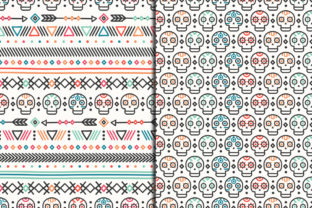
Day of the Dead Patterns: A Practical, High-Resolution Seamless Asset for Design Professionals
Day of the Dead Patterns is a tightly curated, hand-drawn geometric ethnic pattern set designed specifically for designers who need culturally grounded yet versatile visual assets. Unlike mass-produced clipart or generic “Mexican folk” motifs, this collection centers on authentic stylistic cues—calaveras, marigold-inspired symmetry, sugar skull geometry, and pre-Hispanic rhythmic repetition—but reinterprets them through a precise, modern graphic lens. The result is a set of two complementary seamless patterns, delivered in black and white, optimized for scalability, adaptation, and professional integration.
What’s Included—and Why Format Variety Matters
The package contains a total of 16 high-resolution files across four industry-standard formats: 4 Adobe Illustrator (.ai), 4 EPS (compatible with legacy and current vector workflows), 4 JPG (4167 × 4167 px, RGB, ideal for quick mockups or web previews), and 4 PNG with transparent backgrounds (same dimensions, essential for layered design work). This breadth isn’t overkill—it reflects thoughtful preparation for real-world production pipelines.
Designers working in branding, packaging, or textile development often juggle multiple software environments. Having native Illustrator files ensures full editability of paths and anchors; EPS files support compatibility with older systems or print service providers requiring vector fallbacks; high-res JPGs allow fast client presentations without revealing editable vectors; and transparent PNGs are indispensable for digital overlays, UI elements, or social media templates where background context matters. All files maintain consistent scaling and alignment—no re-timing or manual tiling required.
Quality and Craft: Hand-Drawn Precision Meets Technical Rigor
“Hand-drawn” here doesn’t mean loose or inconsistent. Each pattern was constructed using deliberate linework, balanced negative space, and mathematically sound tiling logic. The geometric structure—built around repeating hexagonal and radial units—ensures seamless continuity at any scale, from business card borders to billboard-sized murals. At 4167 × 4167 px, the raster files exceed standard print requirements (300 DPI up to ~14 inches square), and the vector files remain crisp at any output size.
This dual fidelity—artistic intention paired with technical reliability—is where Day of the Dead Patterns distinguishes itself from lower-tier alternatives. Many “ethnic pattern” bundles suffer from uneven line weights, misaligned tiles, or poorly resolved corners that become visible when scaled. These patterns avoid those pitfalls. Tested across CMYK print proofs and RGB screen displays, they retain clarity and visual weight without aliasing, moiré, or registration drift.
Flexibility Without Compromise
Black-and-white delivery is a strategic strength—not a limitation. It allows immediate recoloring in design software (via global swatches, adjustment layers, or live paint) to match brand palettes, seasonal campaigns, or accessibility needs. A marketer launching a Día de Muertos-themed product line can apply warm terracotta and gold foil digitally; an educator building classroom materials can shift to high-contrast purple/white for dyslexia-friendly reading; a publisher designing a literary journal cover can invert tones for dramatic impact—all without altering underlying structure.
Because the motifs are abstracted rather than literal (e.g., no full-face calaveras or overt religious iconography), the patterns function effectively beyond strictly cultural contexts. They’ve been used successfully in editorial layouts for articles on memory and legacy, in UX interfaces for wellness apps referencing cyclical renewal, and in architectural visualization as subtle wall textures for cultural centers. Their neutrality—rooted in geometry, not narrative—broadens applicability while retaining symbolic resonance.
Who Benefits Most—and Where It Fits Workflow
Freelance designers building identity systems for restaurants, boutiques, or festivals find Day of the Dead Patterns especially useful for creating cohesive, scalable texture libraries—think napkin prints, menu backgrounds, or social media story frames. Small business owners managing their own marketing (e.g., artisanal candle makers or independent bookstores) appreciate the plug-and-play usability: drag into Canva or Figma, adjust hue/saturation, and deploy across Shopify banners, email headers, and Instagram posts in under ten minutes.
Educators developing culturally responsive curriculum materials benefit from the respectful abstraction—these patterns invite discussion about symbolism, symmetry, and tradition without appropriating sacred forms. Bloggers and content creators covering Latin American art, anthropology, or design history use them as clean, attribution-appropriate visual anchors for long-form pieces.
That said, it’s not a universal solution. If your project requires photorealistic florals, bilingual typography, or region-specific regional variations (e.g., Oaxacan vs. Michoacán motifs), this set won’t fulfill those needs. It also assumes baseline familiarity with vector/raster file management—beginners may need brief orientation on using .ai or EPS files in their preferred tools.
Real-World Performance and Long-Term Utility
In practice, users report strong performance across three key areas: speed of integration, consistency across outputs, and longevity of relevance. One packaging designer reused Pattern #1 across six product SKUs over 18 months—including matte-finish stickers, embossed boxes, and woven labels—with zero revision requests related to pattern integrity. Another university press used both patterns interchangeably in a series of academic monographs on ritual and material culture, adjusting only color and scale to differentiate volumes—reducing design time per title by roughly 35%.
Long-term value stems from modularity. Because each pattern is self-contained and resolution-agnostic, it integrates cleanly into growing asset libraries. Designers report repurposing tiles as SVG icons, breaking down elements into custom brushes for Procreate or Illustrator, or converting segments into embroidery stitch maps. The absence of embedded gradients or effects means future-proof compatibility—even as software updates deprecate certain features, the core vector paths remain fully functional.
A Final Consideration: Intentionality Over Decoration
Day of the Dead Patterns succeeds because it treats cultural reference as a design constraint—not a decorative shortcut. Its value lies in how it supports thoughtful execution: helping professionals communicate meaning through form, scale, and contrast—not just add “ethnic flair.” That makes it especially suited for teams prioritizing authenticity, clarity, and craft over trend-chasing.
If your work involves translating cultural concepts into visual language—whether for commerce, education, or creative expression—this set provides reliable, adaptable, and respectfully abstracted foundations. It won’t replace research or consultation, but it does remove technical friction from the process of building something meaningful, well-made, and ready for real use.