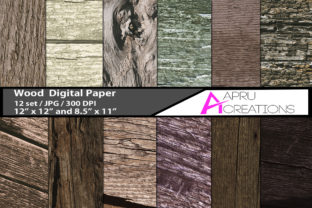
Wood Digital Papers and Patterns: High-Resolution, Versatile Design Resources for Real Creative Work
If you’ve ever spent 20 minutes searching for the perfect woodgrain background—only to find low-res PNGs with blurry edges or distracting watermarks—you’ll appreciate what Wood Digital Papers and Patterns delivers: twelve clean, high-fidelity digital papers, each thoughtfully sized for immediate use in both physical and digital projects. No upselling. No hidden layers. Just 12 JPG files—300 DPI, transparent background, no watermark—ready to drop into your next craft, design, or print job.
What You Actually Get (and Why It Matters)
Each download includes twelve individual JPG files. Every pattern comes in two standard printable sizes: 12 x 12 inches (ideal for scrapbooking layouts, custom wrapping paper, or large-scale stencils) and 8.5 x 11 inches (perfect for printable cards, classroom handouts, or quick gift tags). These aren’t compressed web previews—they’re production-ready files built for clarity and flexibility.
The transparency isn’t just convenient—it’s functional. Whether you’re layering a subtle wood grain over a photo in Photoshop, cutting out a shaped card base in Cricut Design Space, or overlaying texture on a Canva presentation slide, that alpha channel gives you full control. And because there are no watermarks, your final output looks polished—not like something pulled from a free stock site.
Where People Use Wood Digital Papers and Patterns—Not Just “How”
Crafters don’t buy digital papers to collect them. They buy them to solve problems. Here’s how real users apply Wood Digital Papers and Patterns across everyday situations:
- Scrapbookers use the 12×12 files as foundational backgrounds for memory pages—especially for nature-themed albums, family cabin trips, or rustic wedding keepsakes. The grain adds warmth without competing with photos.
- Card makers print the 8.5×11 versions onto heavyweight cardstock, then cut them down for layered bases or die-cut accents. One user told us she used a single wood pattern to create 42 matching thank-you cards for her small-batch candle business—no design fatigue, no licensing worries.
- Small business owners incorporate the textures into product packaging mockups, Etsy listing banners, or social media posts. A local woodworking studio used one of the patterns as a subtle border on their Instagram Story highlights—adding cohesion without shouting “handmade.”
- Educators print the files on label paper to create tactile, wood-textured flashcards for early literacy units—or laminate them for durable classroom sorting mats during sensory play stations.
- Bloggers and content creators layer the transparent JPGs behind text blocks in newsletter graphics or Pinterest pins. The grain adds depth but stays legible, unlike busy photographic backgrounds that drown out headlines.
Real Scenarios—Not Just Categories
Think about Maya, a freelance graphic designer who builds brand kits for eco-conscious startups. She recently used three Wood Digital Papers and Patterns files to develop a cohesive visual language for a new zero-waste skincare line—including packaging labels, website hero banners, and printable order inserts. Because all twelve patterns share consistent tone and resolution, her client didn’t need to approve “which wood looks most authentic.” They trusted the set.
Or consider David, who runs a weekend woodworking workshop for teens. He prints the 8.5×11 versions onto kraft paper, cuts them into puzzle pieces, and uses them as tactile reference guides during grain-identification exercises. The transparency lets him add handwritten notes directly over the texture—no glare, no pixelation under classroom lighting.
Even hobbyists with tight budgets benefit. One customer shared how she printed four of the patterns onto freezer paper, ironed them onto fabric scraps, and created a set of reusable gift wraps—replacing disposable paper every holiday season. That’s not theoretical sustainability. That’s measurable reuse.
What to Consider Before You Download
Know your workflow. If you primarily work in Procreate or Affinity Designer, remember these are JPGs—not layered PSDs or vector files. That’s intentional: it keeps file sizes manageable and compatibility broad (no plugin required), but it also means you won’t be editing individual grain lines or adjusting color balance non-destructively.
Check your printer settings. To get true 300 DPI output, make sure your print dialog isn’t defaulting to “draft” or “fast” mode—and confirm your paper type matches the selected profile (e.g., matte photo paper vs. cardstock). A mismatch here can mute contrast or blur fine grain details, even though the file itself is crisp.
Think beyond “background.” These patterns hold up well when scaled down to 2–3 inches for digital stickers, SVG cut files, or embroidery hoop templates. One quilter used a rotated version of Pattern #7 as a repeating motif in a quilt-label design—proof that utility extends far beyond flat surface coverage.
Why Quality Shows Up Where It Counts
You won’t see dramatic differences in preview thumbnails—but you will notice them when you zoom in at 200% in Illustrator, when you hold a freshly printed card up to natural light, or when you scroll past dozens of similar listings on a marketplace and realize none of them offer both sizes *and* transparency *and* no watermark.
That consistency matters in practice. When you’re batch-producing 50 handmade ornaments and need identical grain direction across every tag, having uniform resolution and alignment saves time—and avoids last-minute reprints. When you’re building a brand identity system and want to maintain visual harmony across digital ads, printed brochures, and physical signage, knowing your wood texture renders predictably across formats reduces revision rounds.
It’s not about owning “more” patterns. It’s about owning twelve patterns that behave reliably—across software, across scales, across mediums—so your focus stays where it belongs: on the person receiving the card, the student holding the flashcard, the customer opening the package.
Who Benefits Most—and How It Fits Their Day
Hobbyists get simplicity: drag, drop, print. Educators get reproducibility: one download supports dozens of students, year after year. Entrepreneurs get speed: no waiting for custom design quotes, no worrying about commercial-use clauses buried in fine print. Bloggers get authenticity: texture that feels grounded, not generic. Even marketers building seasonal campaigns—think autumn promotions, cabin-core aesthetics, or earthy wellness launches—find these patterns slot in naturally, without forcing a trend.
None of this requires design expertise. You don’t need to know CMYK vs. RGB to use them well. You just need a project that calls for warmth, tactility, or quiet sophistication—and a file that works the first time you open it.