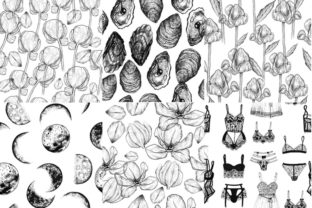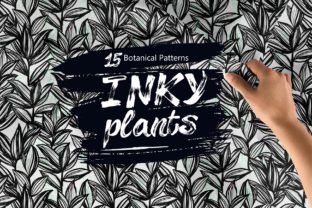
Inky Plants: 15 Botanical Patterns
If you’ve ever searched for elegant, hand-drawn botanical motifs that work as hard as you do—whether you’re designing a greeting card, printing fabric, or building a brand identity—you’ll appreciate what Inky Plants - 15 Botanical Patterns offers. This isn’t just another clipart pack. It’s a thoughtfully curated set of black-and-white ink illustrations, each drawn by hand with expressive line work and natural rhythm. The result? A versatile, timeless collection that feels personal but scales beautifully across media.
What Makes These Patterns Stand Out?
Each of the 15 patterns is built from real ink strokes—not vectorized traces or AI-generated approximations. That means subtle variations in line weight, organic imperfections, and a tactile authenticity you can’t replicate with filters or scripts. They’re designed to repeat seamlessly, so whether you’re tiling them across wrapping paper or filling a web background, edges align cleanly without visible breaks or awkward gaps.
The monochrome palette is intentional: it ensures flexibility. You can recolor any pattern in seconds using design software, print it in rich black ink on kraft paper, or overlay it on photos with blending modes. No color restrictions mean no creative limits.
Where These Patterns Truly Shine
Think beyond “just decoration.” These patterns solve real design challenges—especially when you need something distinctive but not distracting.
- Small business owners use them for branded packaging—imagine a soap label with a delicate fern repeat, or a bakery box wrapped in a soft eucalyptus pattern.
- Educators and workshop leaders print them on handouts, flashcards, or classroom banners—botanical themes resonate with nature-based learning, mindfulness activities, or science units.
- Fabric designers and crafters scale them for quilting cotton, linen napkins, or even embroidery transfers—the clean lines hold up well at both small and large sizes.
- Bloggers and content creators drop them into Canva or Figma as subtle website backgrounds, newsletter dividers, or Instagram story frames—adding visual warmth without competing with text.
And because they’re high-resolution (300 dpi, 5000 px wide), they print crisply on everything from postcards to wallpaper rolls—even large-format wall decals.
More Than Just Repeating Motifs
The real value of Inky Plants - 15 Botanical Patterns lies in its thoughtful extras. Alongside the core patterns, you get four carefully chosen EPS files—each designed for precision and flexibility:
- A floral frame EPS—ideal for certificates, invitations, or social media announcements where you want gentle botanical framing without full coverage.
- A dual floral border EPS—perfect for wrapping paper edges, book chapter dividers, or elegant email footers.
- An isolated leaves EPS—great for customizing greeting cards, layering over photos, or creating your own repeating pattern from scratch.
- Two highly detailed single-plant EPS files: one protea, one artichoke—both rendered with intricate ink texture, making them ideal focal points in branding, logos, or editorial illustrations.
All come with JPG previews at the same resolution, so you can preview before opening in Illustrator or Affinity Designer—no guesswork, no surprises.
Who Benefits Most—and Why
This collection meets people where they are. Beginners love how easy it is to start: open a file, drag it into your project, adjust size or color, and go. No steep learning curve, no complex settings. Professionals appreciate the production-ready quality—CMYK-safe grayscale, vector scalability, and seamless tiling baked in from the start.
Freelancers often tell us they use Inky Plants - 15 Botanical Patterns to speed up client projects: a stationery suite gets done faster, a fabric line concept comes together in half the time, and a digital course landing page gains instant visual cohesion—all without sacrificing originality.
Even hobbyists find unexpected uses: turning a leaf motif into iron-on transfers for tote bags, scanning a border into Procreate to animate it, or printing a protea illustration onto handmade journals.
Things to Keep in Mind Before You Use Them
While these patterns are incredibly flexible, a few practical notes help you get the best results:
- Software compatibility: The EPS files work best in vector editors like Adobe Illustrator or Affinity Designer. If you’re using Canva or Photoshop, stick with the JPG previews for quick placement—but know that resizing beyond 100% may soften fine ink details.
- Color mode matters: All files are RGB, which is perfect for screen use and most print services. For offset printing, you may want to convert to CMYK manually—or confirm with your printer that RGB-to-CMYK conversion will be handled smoothly.
- Scale with intention: Because the ink lines are expressive, very small scaling (under 15% of original size) can cause thin strokes to disappear. Test prints at your intended size first.
- Licensing clarity: These patterns are for personal and commercial use—including client work—but aren’t meant for resale as standalone clipart or digital assets. You can embed them in physical products, digital templates, or marketing materials freely.
A Pattern Collection That Grows With You
What makes Inky Plants - 15 Botanical Patterns feel lasting—not trendy—is its balance of simplicity and depth. You don’t need to be a botanist to recognize the quiet confidence in a hand-drawn artichoke or the gentle flow of a trailing vine repeat. They invite calm attention, not visual noise.
Whether you’re sketching ideas on paper or building a Shopify store, these patterns support your voice instead of drowning it out. They’re not flashy—but they’re memorable. Not generic—but endlessly adaptable. And unlike trend-driven graphics that date quickly, their ink-and-paper honesty gives them staying power.
So if you’re looking for botanical design elements that feel human-made, work across formats, and quietly elevate your everyday projects—this is a collection worth keeping within easy reach.