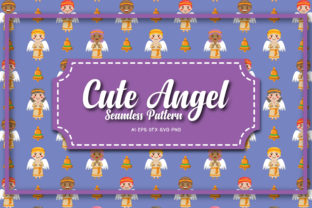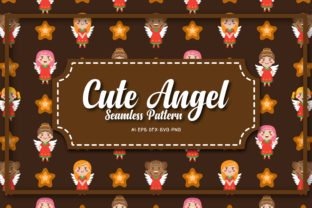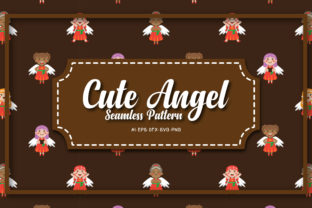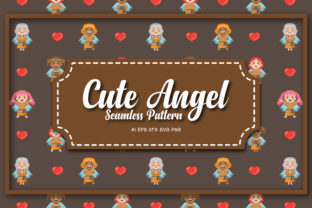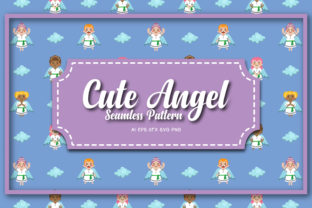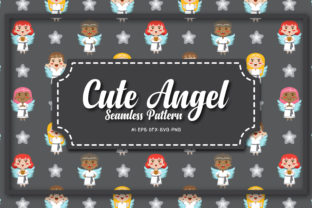
Seamless Patterns Cute Angel 23
Seamless Patterns Cute Angel 23 is a versatile, ready-to-use digital design asset built for both functional efficiency and aesthetic consistency. Unlike one-off illustrations or static backgrounds, this pattern repeats infinitely without visible seams—making it ideal for scaling across surfaces, formats, and applications without manual tiling or alignment. It belongs to a curated set of holiday-themed seamless patterns featuring soft, whimsical angel motifs: gentle wings, delicate halos, subtle stars, and warm neutral tones that evoke quiet reverence rather than overt commercial festivity. Its strength lies not in novelty alone, but in how easily it integrates into existing creative workflows—whether you’re building a brand identity, prepping print materials, or iterating on a client project.
Where Seamless Patterns Cute Angel 23 Fits in Your Design Process
This pattern rarely stands alone as the starting point—but it often becomes a critical accelerant mid-process. For example, when developing custom Christmas party invitations, designers typically begin with layout structure, typography hierarchy, and color palette. Once those foundations are locked in, Seamless Patterns Cute Angel 23 serves as a cohesive background layer that reinforces tone without competing for attention. It’s applied after content strategy is confirmed and before final export—acting as both visual glue and quality control checkpoint. If the pattern aligns cleanly across all invitation sizes (A6, 5×7, digital RSVP cards), it signals that spacing, bleed, and resolution settings are properly configured.
Similarly, in product development for small businesses—say, a boutique selling nursery wall decals—Seamless Patterns Cute Angel 23 can be used early to test scale and proportion. Importing the SVG into vector-based mockup tools lets creators preview how the motif reads at 8 inches versus 24 inches before committing to physical samples. That kind of rapid iteration reduces material waste and speeds up vendor communication. It’s not about adding decoration; it’s about validating dimensional behavior before production begins.
Compatibility Across Tools and Outputs
The delivery formats—SVG, DXF, AI, PNG, EPS—aren’t just convenience features. They reflect intentional compatibility planning. SVG works natively in Figma, Adobe XD, and web builders like Webflow for responsive backgrounds. DXF imports cleanly into Cricut Design Space and Silhouette Studio for cutting vinyl decals or laser-cut wood ornaments. AI and EPS retain full vector fidelity for logo integration or large-format printing. PNG offers quick drag-and-drop use in Canva or PowerPoint for internal presentations or client mood boards.
That multi-format support means you don’t need to convert files mid-project—or risk quality loss from rasterization. If you start in Illustrator (AI) and later shift to a print vendor requiring EPS, no rework is needed. If your team uses different software—some on Affinity Designer, others on InDesign—the shared PNG version ensures visual continuity during review cycles. This eliminates version drift and keeps feedback focused on intent, not technical artifacts.
Practical Implementation Tips for Real Workflows
Start with purpose, not placement. Before dropping Seamless Patterns Cute Angel 23 into a file, ask: Is this serving as texture, framing device, or unifying element? A greeting card might use it subtly behind text (low-opacity PNG overlay), while a t-shirt design may isolate one angel motif from the repeat (using the AI file’s grouping layers). Knowing the role informs format choice and editing depth.
Test scale early—even digitally. Open the SVG in a browser and zoom to 200%. Does the line weight hold? Do halos remain legible? If fine details blur at high zoom, reduce complexity in your final output—for instance, using the EPS version for print jobs above 12×12 inches, where vector precision matters most.
Organize assets proactively. Create a dedicated folder labeled “Seamless Patterns Cute Angel 23 – [Use Case]” (e.g., “– Nursery Art”, “– Invitations”). Inside, store only the formats you’ll actually use for that task—and rename files clearly: “cute-angel-bg_4x4_SVG.svg”, “cute-angel-halo-isolate_AI.ai”. This avoids accidental misapplication (like using a low-res PNG for large wall decals) and saves time during handoff to printers or developers.
Use Cases That Benefit Most From Consistency
- Nursery decor projects: Use the SVG to generate scalable wall stencils or fabric prints. Because the repeat is mathematically precise, you can tile it across irregular wall shapes using pathfinder tools—no gaps or overlaps.
- Branded holiday email campaigns: Apply the pattern as a subtle background in HTML email templates (via inline CSS background-image). The light tonal range ensures readability over white or cream text blocks without contrast issues.
- Educational materials for children: Teachers creating printable Advent calendars or reward charts can layer the PNG over editable PDFs. The angels provide visual warmth without distracting from learning objectives.
- Small-batch merchandise: When designing limited-run stickers or enamel pins, extract single elements from the AI file (e.g., one wing + halo combo) and adapt them to die-cut specifications—retaining stylistic continuity with the broader pattern family.
Long-Term Usability Considerations
Because Seamless Patterns Cute Angel 23 uses a restrained palette and timeless iconography—not trendy gradients or seasonal slang—it remains usable beyond December. The angels read as gentle, inclusive, and non-denominational, making them suitable for baby showers, baptism announcements, or even spring-themed branding refreshes (paired with pastel overlays). That longevity improves ROI: one purchase supports multiple campaigns across calendar years.
Also consider version control. If you modify the original AI file (e.g., recoloring halos gold for a premium line), save the edited version separately—don’t overwrite the source. That preserves flexibility if future projects require the original neutral tones. Naming conventions like “cute-angel-bg_gold-edition_AI.ai” make retrieval predictable.
Integration With Broader Resource Systems
This pattern doesn’t replace brand guidelines—it complements them. If your organization has defined primary/secondary colors, use the EPS version to test how the angels interact with those swatches in real layouts. Does the cream background harmonize with your off-white? Does the soft gray wing tone match your secondary type color? These checks happen naturally during asset review—not as extra steps, but as part of visual QA.
For teams managing shared libraries (e.g., via Dropbox or Brandfolder), upload the SVG and PNG versions to the “Backgrounds” folder and tag them with “seamless”, “holiday”, “angel”, and “print-digital”. That enables search-based discovery without relying on memory or folder navigation—especially helpful for freelancers juggling multiple clients’ asset systems.
In short, Seamless Patterns Cute Angel 23 functions best when treated as infrastructure—not decoration. It’s a calibrated component designed to reduce friction in execution, maintain visual cohesion across touchpoints, and scale reliably from pixel to poster. Its value isn’t in what it adds, but in what it removes: guesswork, revision loops, format anxiety, and inconsistent execution. When aligned with clear goals and organized workflows, it becomes less of a download and more of a reliable step in getting work done well.