Sewing Vector Patterns: Flexible, Scalable Designs for Creative Projects
Whether you're stitching a custom dress, designing a boutique fabric line, or branding a stationery collection, Sewing Vector Patterns offer a rare blend of precision and adaptability. Unlike raster images that blur when enlarged, these patterns are built in vector format—meaning they scale infinitely without losing clarity. What makes them especially valuable for makers and designers is their seamless tiling structure and built-in color flexibility. With three ready-to-use seamless pattern designs included, this set bridges the gap between craft tradition and digital efficiency.
What Exactly Are Sewing Vector Patterns?
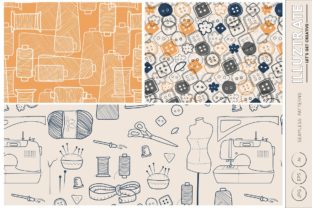
Sewing Vector Patterns refer to digitally crafted, repeatable motif arrangements designed specifically with textile and surface design in mind—but optimized for broader creative use. Each pattern is constructed as a mathematically precise tile that aligns perfectly at its edges, enabling smooth, invisible repetition across any surface. Because they’re delivered as vector files (AI and EPS), every curve, line, and shape remains fully editable: you can change colors, adjust spacing, isolate elements, or even modify individual motifs without degradation.
The included set features three distinct seamless pattern designs, each thoughtfully composed for visual harmony and functional versatility. These aren’t generic clipart repeats—they’re balanced, rhythmically paced compositions inspired by textile traditions but refined for modern application. Each design ships with both the full tile and a labeled pattern swatch, so you instantly understand how it repeats and where to make edits.
What’s Inside the Package?
- 3 AI vector files — Fully layered, editable in Adobe Illustrator (CS6+)
- 3 EPS vector files — Compatible with CorelDRAW, Affinity Designer, Inkscape, and more
- 3 high-resolution JPEGs — 12×12 inches at 300 DPI, ideal for mockups, presentations, or quick print tests
- Each file includes the seamless tile and a clearly labeled pattern swatch for immediate reference
Why Seamlessness Matters—Beyond Just Aesthetics
A seamless pattern isn’t just about looking polished—it’s about practicality. When a design repeats without visible seams or misaligned edges, it eliminates costly production errors. For example, if you’re printing on fabric yardage, a non-seamless repeat could cause noticeable “jumps” every 12 inches—ruining flow and professionalism. With Sewing Vector Patterns, that risk disappears. The tile is engineered so that the right edge matches the left, and the top aligns flawlessly with the bottom.
This feature becomes indispensable when adapting designs across formats: a pattern that works on a 45-inch-wide cotton bolt will also scale cleanly for a 6-inch phone case background or a 24-inch desktop wallpaper. No reworking. No pixelation. Just consistent, reliable repetition.
Who Benefits Most from These Patterns?
The strength of Sewing Vector Patterns lies in its wide accessibility—not just to experts, but to anyone who values time, quality, and creative control.
- Independent sewists and small-batch makers can customize motifs to match fabric dyes, thread palettes, or seasonal collections—no need to hire a designer for minor tweaks.
- Stationery designers use the vectors to create cohesive wraparound notebook covers, gift tags, or printable planner inserts—all with crisp, scalable detail.
- Print-on-demand sellers integrate the files directly into platforms like Printful or Gelato, adjusting colors to fit brand guidelines in seconds.
- Teachers and workshop leaders use the JPEGs for handouts and the vectors for live-editing demos—showing students how color theory or scale affects perception.
- Small business owners apply the same pattern across packaging, website banners, and social media templates—ensuring instant brand recognition.
Real-World Applications You Can Start Today
Here’s how creators are already putting these Sewing Vector Patterns to work:
- Fabric Printing: A quilter imports the vector into Spoonflower’s design tool, swaps the palette to match her autumn fabric line, and orders test swatches—all in under 20 minutes.
- Custom Phone Cases: A Etsy seller uses the 12×12 JPEG to preview how the pattern wraps around a case template, then switches to the AI file to simplify shapes for laser engraving on wood-backed cases.
- Branded Stationery: A wedding planner recolors one pattern in soft sage and ivory, then layers it subtly behind hand-lettered vows on thank-you cards—keeping text legible while adding texture.
- Teaching Resources: A textile arts instructor isolates a single motif from the vector tile, turns it into a cut-out stencil, and uses it for in-person block-printing lessons.
Strengths—and Honest Considerations
Key strengths of Sewing Vector Patterns include their resolution independence, intuitive layering, and intentional design pacing. Because motifs avoid overcrowding or excessive symmetry, they translate well across scales—from embroidery floss charts to billboard-sized murals.
That said, it’s worth noting what these files don’t do: they aren’t pre-sized for specific garments (like a dress sloper or sleeve template), nor do they include embroidery stitch files or SVG cuts for Cricut machines. They’re surface patterns—not construction guides. If your goal is to draft a garment from scratch, you’ll pair these with your own sewing patterns. But if your aim is to give that garment distinctive, professional-grade surface design? That’s exactly where Sewing Vector Patterns shine.
Also, while the JPEGs are print-ready at 12×12", remember they’re meant for proofing—not final large-format output. For wall murals or trade show banners, always use the vector source and scale within your layout software.
How to Choose the Right Pattern for Your Project
Picking among the three included designs comes down to rhythm, density, and mood—not just personal taste.
- Design One features open spacing and delicate line work—ideal for lightweight fabrics, minimalist branding, or subtle backgrounds where legibility of overlaid text matters.
- Design Two balances medium-scale motifs with gentle movement—perfect for quilting cotton, tote bags, or notebook covers needing visual interest without distraction.
- Design Three offers tighter repetition and bolder silhouettes—best suited for upholstery, phone cases, or apparel where impact and durability are priorities.
You’re not locked in. Since all files are vectors, you can lighten a bold design with transparency, condense spacing in an airy one, or even combine motifs across files—just copy and paste between layers.
Getting Started Is Simpler Than You Think
No advanced vector skills required. Open any AI or EPS file in compatible software, click on a shape or group, and use the color picker to change hues. Want warmer tones? Shift all blues to terracotta. Prefer monochrome? Convert everything to grayscale and adjust contrast. Need it smaller? Scale the entire tile uniformly—the seamlessness holds.
Even if you’ve never edited a vector before, start by duplicating the swatch layer, locking the original, and experimenting on the copy. Within minutes, you’ll see how effortlessly these Sewing Vector Patterns respond to your vision—not the other way around.
In a landscape crowded with static PNGs and inflexible templates, Sewing Vector Patterns stand out by honoring both craft and convenience. They respect your time, support your growth, and scale with your ambition—whether you’re stitching your first pillow or launching a global fabric brand.