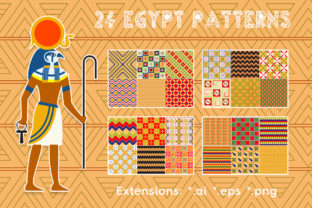
24 Egypt Patterns: Authentic Egyptian Design Assets
For designers, educators, marketers, and makers seeking culturally grounded visuals, 24 Egypt Patterns offers more than decorative motifs—it delivers a curated bridge between ancient symbolism and modern application. This collection includes 24 distinct national Egyptian patterns and 24 matching pattern backgrounds—each rooted in folklore, architecture, textile traditions, and natural elements native to Egypt’s cultural landscape. Unlike generic “Egyptian-style” graphics, these assets reflect authentic visual language: lotus blossoms, scarab motifs, geometric Nile-inspired repeats, hieroglyphic rhythms, and stylized papyrus forms—all interpreted with clarity and respect.
The files come in versatile formats: vector (EPS and AI) at 2000 × 2000 px for infinite scalability, and high-resolution raster (PNG) at 16000 × 16000 px for print-quality output. That means you can use the same file on a business card, a mural-sized wall decal, or a digital ad without losing fidelity or intent.
Creative Possibilities That Go Beyond Decoration
Patterns are rarely just background noise—they’re narrative tools. With 24 Egypt Patterns, each design carries subtle meaning that can be leveraged intentionally. A repeating ankh motif isn’t just elegant; it signals continuity and life—ideal for wellness branding or educational materials about heritage. A grid of interlocking djed columns suggests stability and endurance—useful in finance, architecture, or civic campaign visuals. Even the color-ready PNGs retain flexibility: layer them over photos, apply duotones, or isolate elements using clipping masks in Photoshop or Illustrator.
Designers working on book covers, packaging, or editorial layouts can mix and match patterns from the set to build visual hierarchies. For example, use one bold pattern as a chapter divider, a subtler variant as a page border, and a third as texture behind pull quotes. Because all 24 patterns share consistent line weight, scale logic, and spacing rhythm, they harmonize without needing manual adjustment.
Real-World Applications Across Roles
For educators and curriculum designers: These patterns support culturally responsive teaching. Embed them into worksheets about ancient civilizations, use them as thematic backdrops for student presentations on African art history, or adapt them into hands-on activities—like tracing symmetry in a cartouche-based repeat or mapping how water motifs reflect Nile geography.
For small business owners and entrepreneurs: A boutique selling handmade ceramics, natural skincare, or linen goods can use these patterns to unify their brand system—from product labels and social media banners to email headers and unboxing inserts. One café owner used the “Lotus Grid” pattern as a subtle watermark on receipts and loyalty cards, reinforcing regional identity without overwhelming customers.
For bloggers and content creators: Stand out visually in crowded feeds by replacing generic stock textures with culturally resonant patterns. A travel blogger documenting Cairo markets applied the “Bazaar Stripe” background behind Instagram Stories—adding depth while grounding the content in place. Another used the “Temple Lattice” as a subtle overlay on podcast cover art, signaling depth and timelessness without distracting from the title.
For publishers and freelancers: When designing illustrated children’s books or nonfiction titles on archaeology or African studies, these patterns offer ready-made, respectful visual scaffolding. One illustrator layered the “Papyrus Scroll” pattern beneath hand-drawn figures to imply context—not costume—making historical scenes feel immersive rather than theatrical.
How to Maintain Clarity and Cultural Integrity
Using traditional patterns well means honoring their origin—not flattening them into aesthetic props. Start by reviewing the included documentation (if available) or researching the source references behind each motif. Ask: Is this pattern historically associated with royalty, ritual, or daily life? Does its repetition carry symbolic weight—or is it purely ornamental?
Keep compositions legible by limiting pattern density where text appears. Use the vector files to adjust spacing or simplify outlines if needed—especially for small-format applications like app icons or social avatars. And avoid pairing these motifs with unrelated iconography (e.g., pyramids next to palm trees labeled “Egypt”) unless your goal is intentional stylization—not authenticity.
Variations, Stylistic Flexibility, and Platform Adaptation
These patterns aren’t locked into one era or tone. Flip the contrast: invert a dark “Sphinx Weave” pattern to white-on-black for sleek tech branding. Desaturate a “Desert Bloom” repeat for minimalist stationery. Or combine two patterns—one scaled large as a base, another smaller as an overlay—to create custom textures for fabric mockups or web hero sections.
On digital platforms, optimize usage by exporting SVG versions from the AI/EPS files for responsive websites. For mobile-first audiences, test pattern visibility at 320px width—some intricate repeats may need simplification or fallback solid colors. On print, leverage the 16000 × 16000 px PNGs for large-format posters or exhibition panels—just confirm your printer supports CMYK conversion if color accuracy matters.
Freelancers pitching to international clients often face tight timelines. Having 24 Egypt Patterns on hand means you can deliver culturally anchored concepts in hours—not days. One branding consultant built three distinct mood boards for a Cairo-based startup—one using warm earth tones and organic repeats, another with monochrome geometry for a fintech spin, and a third blending gold foil effects over the “Sun Disc” pattern for luxury positioning. All were created using only assets from this single collection.
Practical Tips for Getting Started
- Start simple: Pick one pattern that matches your project’s core message—not just what looks “most Egyptian.”
- Test contrast early: Overlay text on pattern samples before finalizing layouts—especially with busy repeats.
- Respect scale: Vector files let you zoom infinitely, but human perception has limits. A 200% zoom on screen doesn’t equal 200% readability.
- Document usage: Note which pattern you used where—and why. It builds your creative rationale and helps future collaborators understand your intent.
- Think beyond pixels: These files work equally well for laser-cut wood signs, embroidery digitizing, or vinyl decals—explore physical outputs alongside digital ones.
Ultimately, 24 Egypt Patterns serves creators who value intention over imitation. It’s not about evoking “ancient mystery”—it’s about drawing from real visual vocabulary to make work that feels grounded, thoughtful, and adaptable. Whether you’re launching a new brand, illustrating a textbook, or designing a community workshop banner, these patterns offer structure, meaning, and room to build something unmistakably your own—without starting from zero.