Gold Rose Gold Seamless Pet Patterns
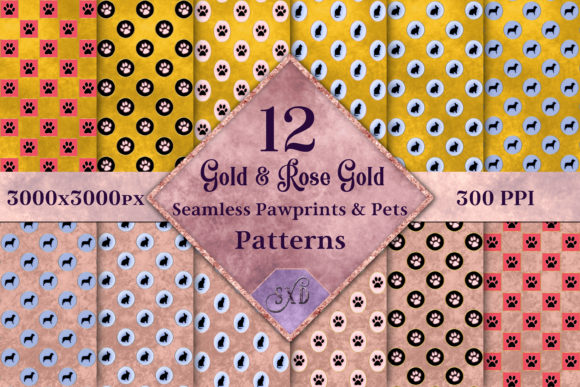
Gold Rose Gold Seamless Pet Patterns is a precision-crafted design resource built for professionals who understand that visual consistency isn’t decorative—it’s operational. This set delivers 6 distinct pet-themed pattern styles—Cat, Rabbit, Dog, Pawprint on Oval Background, Pawprint on Square Background, and Pawprint on Round Background—each rendered in two refined metallic tones: warm gold and soft rose gold. All 12 high-resolution images are 3000×3000 pixels at 300 PPI, delivered as a single compressed .ZIP file. No layers. No vectors. Just production-ready, tileable JPGs—designed to integrate cleanly into real-world workflows without friction or guesswork.
Why Seamless Pet Patterns Matter Strategically—Not Just Aesthetically
When you choose Gold Rose Gold Seamless Pet Patterns, you’re not selecting background textures—you’re selecting a decision-making lever. Seamless patterns reduce cognitive load in visual communication: they unify disparate elements (product mockups, social banners, presentation slides, packaging prototypes) under a shared tonal language. Gold and rose gold aren’t arbitrary choices here—they signal warmth, approachability, and quiet sophistication. That matters when positioning a pet wellness brand, launching a boutique grooming service, or designing educational materials for animal behavior courses. The consistent use of these tones across touchpoints builds associative memory faster than color alone ever could.
Consider this: a small business owner creating branded email templates, Instagram story overlays, and printable client handouts doesn’t need 47 variations of pawprints. They need one cohesive system—reliable, scalable, and context-aware. Gold Rose Gold Seamless Pet Patterns provides that system without requiring design expertise or licensing negotiations. It removes the “what should this look like?” question so energy can shift to “what outcome do we want this to drive?”
When—and When Not—to Use These Patterns
Use Gold Rose Gold Seamless Pet Patterns when visual continuity supports your objective—not when it distracts from it. For example:
- A freelance illustrator building a portfolio website might apply the Cat design pattern as a subtle background behind case study thumbnails—adding texture without competing with artwork.
- An educator developing printable worksheets for elementary animal science units could use the Pawprint on Round Background variation as a gentle frame around diagrams—guiding attention while reinforcing theme.
- A pet product startup preparing investor pitch decks might layer the Rabbit design pattern into slide footers—creating rhythm and reinforcing brand identity across 20+ slides without repetition fatigue.
Avoid using these patterns where clarity, hierarchy, or accessibility take priority over atmosphere. Don’t overlay text directly onto busy sections of the Dog design pattern without testing contrast ratios. Don’t default to gold tones for all communications if your audience includes older adults or those with low vision—rose gold offers higher luminance contrast against white backgrounds and often performs better in print.
Planning Your Integration—Beyond Drag-and-Drop
Intentional use starts before opening the ZIP file. Ask three questions first:
- What’s the primary action I want users to take? If it’s signing up for a newsletter, prioritize clean space and clear CTAs—use the pattern minimally (e.g., as a border or header accent), not as full-background filler.
- Where will this appear most frequently? Social media? Print brochures? Digital ads? The Pawprint on Square Background works efficiently in Instagram feed posts; the Oval Background adapts more naturally to email newsletter headers or PDF report covers.
- What existing assets must it align with? Check your current logo lockup, typography scale, and dominant brand colors. Gold Rose Gold Seamless Pet Patterns complements muted palettes and serif/sans-serif pairings—but clashes with neon gradients or ultra-bold display fonts unless deliberately contrasted.
Also consider timing: launching a holiday collection? The rose gold variants harmonize well with soft pinks, creams, and charcoal—ideal for Q4 campaigns. Rebranding a legacy pet clinic? Gold carries gravitas and tradition; pairing it with clean sans-serif type signals both trust and modernity.
Risks of Using Without Context—or Goals
The biggest risk isn’t technical—it’s strategic drift. Downloading Gold Rose Gold Seamless Pet Patterns and applying it everywhere “because it looks nice” dilutes meaning. Overuse blurs differentiation. A veterinary practice using the same pawprint-on-oval pattern for its website, invoices, lab reports, and staff ID badges risks visual fatigue—and worse, implies uniformity where nuance matters (e.g., clinical documentation vs. community outreach).
Another underdiscussed risk: tone misalignment. Gold conveys premium, but also formality. Rose gold suggests tenderness—but can read as overly delicate in contexts demanding authority (e.g., pet insurance policy documents or safety guidelines). Without mapping pattern choice to message intent, you risk sending contradictory signals. A children’s pet therapy program benefits from the playfulness of the Rabbit design; a canine rehabilitation center may find more resonance in the grounded symmetry of the Square Background version.
How to Build Long-Term Value From One Pattern Set
Treat Gold Rose Gold Seamless Pet Patterns not as decoration, but as infrastructure. Archive each variant with clear naming conventions: gold-cat-seamless-3000x3000.jpg, rose-gold-paw-oval-3000x3000.jpg. Document usage rules in your brand guide—even if it’s one page. Note things like: “Rose gold variants only for consumer-facing materials; gold variants reserved for B2B or partnership collateral.” That discipline pays off when onboarding contractors or scaling content output.
You can also extend utility without new assets. Try these practical adaptations:
- Convert the Pawprint on Round Background into a watermark for digital certificates or downloadable resources—reducing visibility while preserving recognition.
- Use the Dog design pattern as a base layer in Photoshop, then apply a 15% opacity gradient mask to create depth behind hero text—no extra design time required.
- Import any pattern into Canva, set it as a background, then add semi-transparent white shapes (circles, rectangles) to create modular content zones—ideal for blog post graphics or workshop handouts.
None of this requires advanced skill—just intention. And intention compounds. Every time you choose which pattern to use—and where and why—you reinforce clarity of purpose. That clarity becomes visible to your audience long before they read a single word.
Final Consideration: What You’re Really Investing In
You’re not buying 12 JPG files. You’re buying decision efficiency, visual coherence, and time reclaimed. For a freelancer juggling five clients, minutes saved on background design add up to hours redirected toward strategy or client dialogue. For an educator, consistent patterns mean less time formatting and more time refining learning outcomes. For a small business owner, predictable aesthetics reduce revision cycles with designers—and build confidence in DIY updates.
Gold Rose Gold Seamless Pet Patterns earns its place not by being flashy, but by being dependable. It works within constraints—print specs, CMS limitations, team skill levels—without demanding trade-offs in quality or professionalism. Used thoughtfully, it supports goals quietly, consistently, and without fanfare. That’s not just design. It’s leverage.